
Introduction: The Cinematic Shift in Post-Production Workflows
High-end digital camera sensors capture immense dynamic range data, far more visual information than traditional mastering workflows can preserve. For decades, filmmakers compressed this raw footage down into standard dynamic range formats, losing valuable shadow details and peak highlight information in the process. Today, this is changing fundamentally.
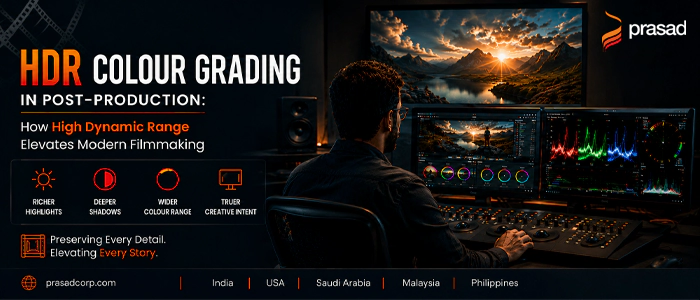
Modern studios now utilize native HDR colour grading in post-production from day one, ensuring that the full spectrum of data captured by cinema cameras translates directly to final delivery masters. Rather than treating HDR as a post-process conversion, leading post-production facilities increasingly integrate high dynamic range workflows into contemporary mastering processes.
To experience absolute visual precision, filmmakers utilize calibrated HDR colour grading suites to finish stories exactly how they were meant to be viewed. This capability has become non-negotiable for anyone serious about cinematic storytelling.
Technical Growth: The Industrial Mandate for High Dynamic Range
The transition to HDR grading in post production is not speculative or optional, it’s industry-wide and accelerating.
The Streaming Standard: A Hard Delivery Requirement
Major global distribution channels now enforce strict ingestion guidelines that prioritize HDR delivery:
- Netflix, Amazon Prime Video, and Apple TV+ mandate native Dolby Vision or HDR10 master delivery for original programming
- This is a contractual requirement, not a preference
The Display Evolution: Consumer Hardware is Already Here
Consumer adoption of HDR-capable displays is growing exponentially. Standard SDR content increasingly appears flat and outdated on modern displays. Colorists working in traditional SDR workflows risk their finished work appearing technically inferior on the screens audiences actually own.
The Contrast Volume Advantage: A 70% Visual Spectrum Expansion
Working in high dynamic range expands the available color volume palette by over 70% compared to traditional SDR grading:
- Bright highlights can shine without blooming or washing out
- Dark shadows retain texture and detail without crushing
Precision Controls: Why HDR Elevates Film Color Grading
Grading in HDR within a modern post-production pipeline represents more than a technical upgrade, it’s a fundamental expansion of creative storytelling capability.
Specular Highlights: Preserving Brightness Without Destruction
In traditional SDR colour grading, bright elements face critical constraints. Pushing highlights too far causes “washout,” resulting in the loss of detail and texture. Sunlight or explosions become blown-out areas instead of naturally luminous elements.
Grading in high dynamic range solves this by extending peak brightness far beyond SDR limits. Professional HDR masters are typically created at 1,000–4,000 nits, while modern HDR displays can achieve even higher peak brightness levels, enabling more realistic highlights and greater visual impact.
As a result:
- Bright highlights retain their full intensity while preserving surrounding detail.
- Visual noise and compression artifacts are significantly reduced.
Shadow Fidelity: Clean Blacks Instead of Crushed Shadows
SDR workflows suffer from notorious “crushed blacks”, dark shadow areas that collapse into featureless voids. Character expressions disappear in shadowed areas and fabric texture is lost.
Working natively in HDR expands shadow detail throughout the tonal range:
- Shadows remain clean, readable, and textured without crushing
- Character expressions and environmental detail survive in dark areas
Creative Uniformity: Director's Intent Survives the Distribution Chain
HDR colour grading creates a standardized encoding architecture that protects the director’s exact visual intent. Color decisions made during grading translate predictably across theatrical, streaming, and consumer displays – an advantage that is more difficult to maintain in SDR workflows, where compression can affect the final visual presentation.
Technical Display Architecture in Modern Post-Production
The mastering framework for contemporary HDR colour grading in post production differs significantly based on the ultimate exhibition format:
| Mastering Framework | Target Peak Brightness | Primary Mastering Output | Primary Distribution Target |
|---|---|---|---|
| Premium Streaming / Home | 1,000 – 4,000 Nits | Dolby Vision / HDR10+ Master | Global OTT Streaming, Premium Home TV |
| Premium Large Theatrical | 108 – 300 Nits | Digital Cinema Package (DCP HDR) | Premium Large Format (PLF) Exhibition |
| Legacy Display / Mobile | 100 Nits | Standard SDR Master Archive | Standard Television, Web Proxies, Mobile |
Modern post-production pipelines typically generate three parallel masters from a single grade session: a premium HDR master for streaming platforms, a theatrical DCP for cinema exhibition, and an SDR fallback for legacy systems. This multi-master approach requires specialized knowledge of HDR colour grading principles across each format’s unique technical constraints.
HDR Cinema Exhibition: The Growing Global Ecosystem
The global HDR cinema ecosystem continues to expand as premium HDR exhibition technologies gain wider adoption across theatres worldwide, enabling the presentation of commercial HDR-graded Digital Cinema Packages (DCPs).
Two leading technologies are driving this evolution:
- Dolby Vision: Dolby Cinema theatres utilize dual 4K laser projection systems capable of presenting specially mastered HDR DCPs with exceptional contrast, deep blacks, and peak brightness of up to 108 nits.
- Barco HDR by Lightsteering: Powered by Barco’s Lightsteering technology, Barco HDR delivers true cinema HDR with brightness levels of up to 300 nits, providing greater highlight detail, enhanced contrast, and improved visual realism for theatrical exhibition.
As HDR cinema adoption continues to grow, theatres must be equipped to deliver a true 300-nit HDR cinema experience. At Prasad Corp’s Chennai Barco HDR Grading Suite, we create HDR masters optimized for Barco HDR workflows, ensuring content is prepared for next-generation theatrical exhibition.
FAQs: Professional Insights for Post-Production Decision-Makers
1. What is the main benefit of grading in high dynamic range?
2. What is the difference between Dolby Vision and standard HDR10 masters?
3. Can independent feature films utilize professional HDR post-production pipelines?
4. Should our facility invest in HDR grading capability?
Conclusion:
High Dynamic Range is the definitive global delivery baseline for professional film and episodic content. Working natively in HDR ensures that specular highlights retain luminous detail without blooming, shadows preserve texture without crushing, and the director’s creative vision translates faithfully across every exhibition format.
Prasad Corp specializes in professional HDR grading in post production for filmmakers and studios across India, the USA, Saudi Arabia, Malaysia, Philippines, Japan and France. Our facilities deliver calibrated HDR masters that meet Netflix, Apple TV+, and theatrical DCP specifications ensuring your work looks exactly as intended, everywhere it’s viewed.