Walk onto a post-production floor in Chennai, Mumbai, or Hyderabad today and the workflow looks nothing like it did five years ago. Editors are cutting faster, colourists are grading in real time instead of overnight, and VFX teams are building shots that once needed a Hollywood-sized budget. Post production trends in Indian cinema in 2026 point in one direction: AI has moved from novelty to working partner in the edit suite, and the industry is scaling because of it, not despite it.
AI Is Rewriting the Edit Bay
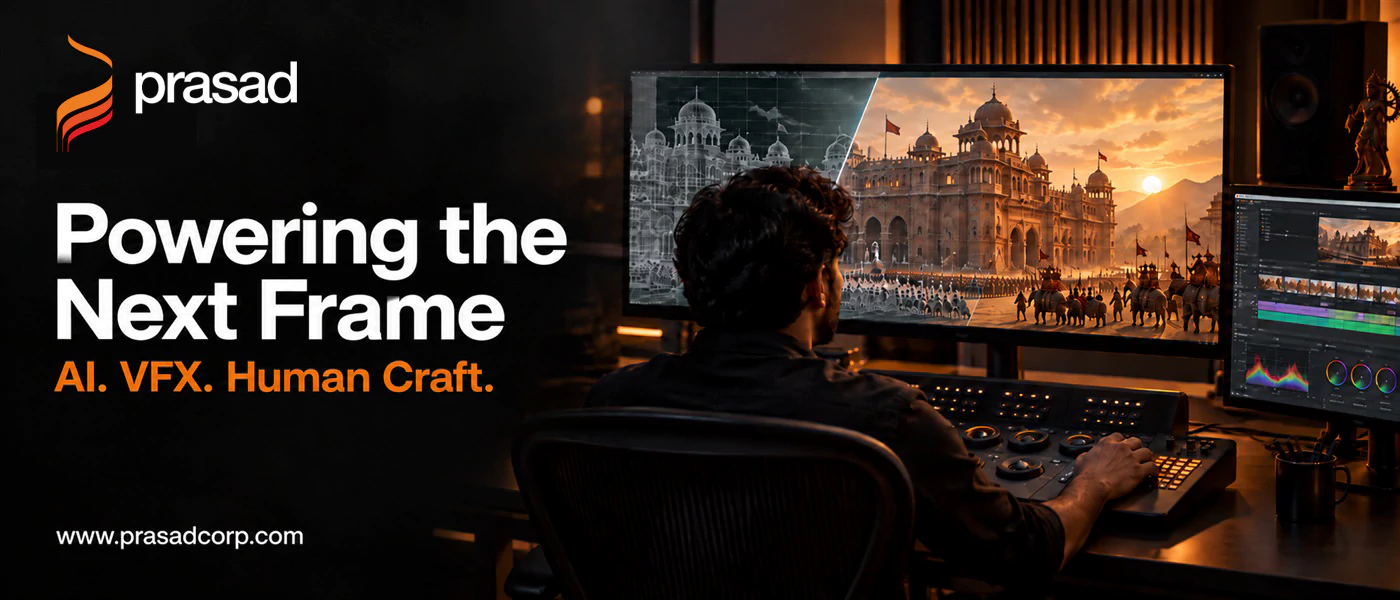
AI in film post production now handles the repetitive first pass that used to eat up an editor’s week, freeing editors and colourists for the creative calls that actually shape a film. On a typical project today, AI-assisted tools are doing the heavy lifting on:
- Dailies management — organising and tagging footage as it comes in
- Take selection — flagging usable takes across multi-camera setups
- Footage syncing — syncing multi-camera and multi-mic footage automatically
- Rough assembly — suggesting a first-pass cut an editor then refines
- Shot-to-shot colour matching — giving colourists a strong starting grade instead of a blank timeline
None of this replaces the editor’s or colourist’s eye — it just clears the mechanical work standing between them and the creative decision, cutting turnaround from weeks to days on tight release windows. The gain isn’t anecdotal: the FICCI-EY 2026 report on India’s media and entertainment sector found AI adoption is already delivering up to 40% time savings across VFX and post-production workflows — a clear sign this shift is structural, not a passing trend.
VFX Trends in Indian Cinema Are Catching Up Fast
VFX trends in Indian cinema are moving at a similar pace. Work once reserved for a handful of international studios is now routine on Indian productions, OTT series included:
- De-ageing a lead actor across a multi-decade storyline
- Building digital crowds for a stadium or battle scene
- Creating full CGI creatures and environments
This isn’t a small shift either: India’s animation, VFX, and post-production segment reached Rs 105 billion in 2025 and is projected to grow roughly 10% a year to Rs 138 billion by 2028, per the FICCI-EY 2026 report (via AnimationXpress) — a real recovery after a tougher 2024. A large share of the work still comes from international productions choosing Indian studios for both cost and craft, a sign of the talent here, not just the economics.
Where Prasad Corp Fits into This Shift
This is exactly where our own pipeline has been evolving. A few examples:
- Editing suites across Chennai, Hyderabad, and Mumbai, pairing AI-assisted tools with editors who still make every final call, through our editing and colour grading pipeline
- Colour grading on DaVinci Resolve and Filmlight Baselight, including Dolby Vision HDR mastering
- A Dolby Atmos–certified mixing studio for 5.1, 7.1, and Atmos formats
- A full VFX pipeline running from rotoscope and compositing through 3D environment builds, all in-house
- AI film restoration — a search term we rank first for in India, because buyers want studios that combine AI speed with human supervision, not one or the other
That combination lets a feature or OTT season move from offline edit to finished master and preview theatre QC without the handoff delays that used to stretch a schedule by weeks.
The Craft Is Still the Point
AI is compressing the mechanical parts of post-production, sorting, matching, rough assembly so editors, colourists, and VFX artists spend their time on shots that actually need a human decision. That’s the real story behind post production trends in Indian cinema this year: not AI replacing craft, but craft moving faster because of it.
If your next release needs an editing, colour, or VFX partner that can move at this pace without cutting corners, talk to our team at Prasad Corp, we’ll walk you through how our pipeline can fit your schedule.