A film restored in 2026 might be scanned in one country, repaired frame by frame in another, and approved in Los Angeles. For many studios, this global approach is now the standard way to handle motion picture preservation at scale.
The Archive Problem Keeps Growing
Hollywood’s vaults hold more than a century of work on nitrate, acetate, and polyester film, plus decades of legacy videotape. Acetate naturally develops vinegar syndrome, colours fade, and physical reels shrink. Tape formats face another threat: the legacy playback machinery is rapidly disappearing from the market.
Meanwhile, demand for restored content keeps rising. Streaming platforms need deep libraries to combat subscriber churn, while anniversary re-releases, 4K remasters, and documentary licensing all depend on clean, high-resolution masters. The volume of work is simply too vast for any single city’s infrastructure to handle.
Why US Studios Already Use Overseas Labs
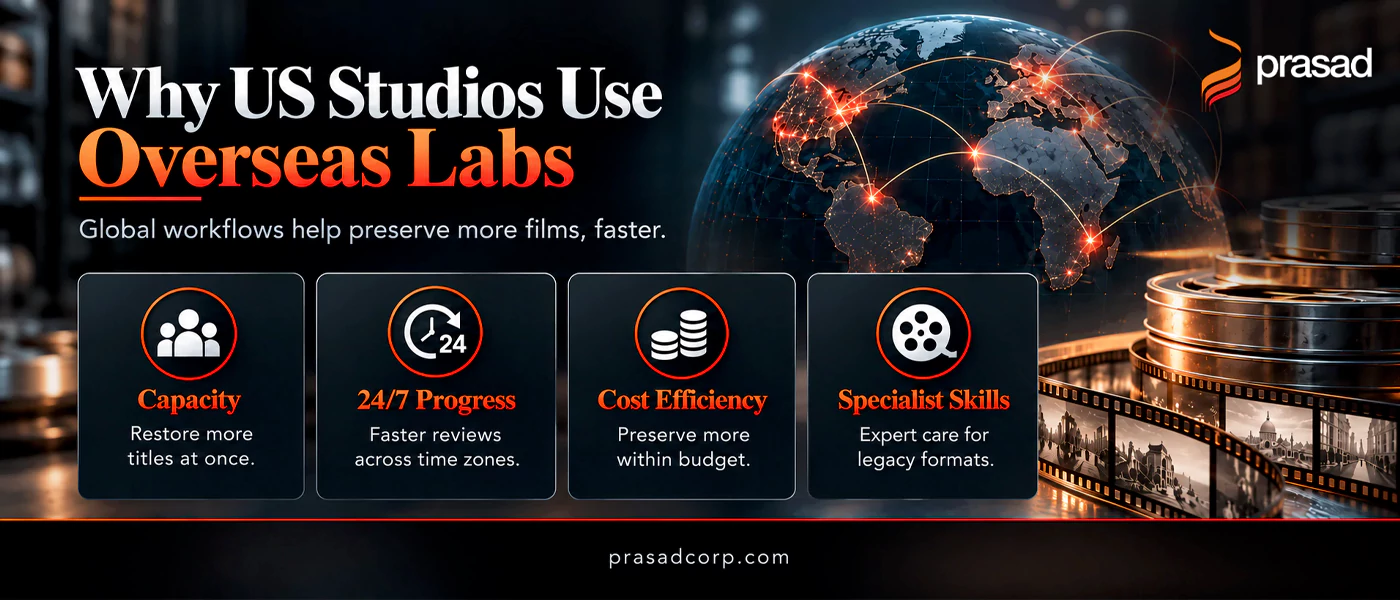
Studios have relied on international partners for visual effects, dubbing, and post-production for years. Restoration has followed the same trajectory for distinct operational reasons:
- Capacity: Global labs with large, highly trained technical teams can take on entire library catalogues concurrently, rather than bottlenecking a studio’s pipeline with just a few titles at a time.
- Round-the-Clock Progress: Drastic time differences facilitate a “follow-the-sun” model, work reviewed in LA at night can be revised overnight and be ready for approval by morning.
- Cost Efficiency: Balanced operating costs allow studios to scale up their preservation initiatives, restoring significantly more titles within the exact same fiscal budget.
- Specialist Skills: Labs that have historically protected complex international cinematic archives bring unmatched experience when handling delicate, multi-generational film formats.
What Archival Film Scanning Services Involve
Scanning is the absolute foundation of every restoration project. Modern archival film scanning services require comprehensive physical prep before digitization begins:
- Meticulous inspection, ultrasonic cleaning, and physical repair of damaged or shrunken film elements.
- High-resolution scanning at 2K, 4K, or native 8K resolution using advanced continuous-motion systems.
- Cross-gauge hardware support for 35mm, 16mm, and specialized archival film sizes.
- Scanning across varied components – negatives, interpositives, and release prints, to extract the highest available dynamic range.
- High-fidelity transfer and synchronization of optical and magnetic soundtracks.
Ultimately, final asset quality depends entirely on engineering precision and film-handling expertise, not geographic location.
End-to-End Media Preservation Services
Studios increasingly prefer a unified vendor pipeline for complex catalog migrations. Complete media preservation services include:
Digital Restoration: Algorithms combined with manual reviews by artists to carefully remove dust, vertical scratches, color breathing and frame tears.
Color Grading: Careful grading that is adjusted using reference prints or through stages where the studio directly approves the work.
Audio Restoration: High-level repair of sound that reduces background noise and hiss while keeping the mix exactly as it was.
Deliverables Management: Putting together full delivery master sets that include Digital Cinema Packages, Interoperable Master Format packages and uncompressed un-graded archival master files, like 16-bit DPX.
How Trust is Built with an Offshore Partner
Before sending irreplaceable film assets or massive digital masters into a global workflow, US studios look for precise validation metrics:
- Content Security: Strict data security alignments and active technical certifications verified via industry-standard frameworks like the Trusted Partner Network (TPN) and ISO/IEC 27001:2022 Certification for Information Security Management Systems (ISMS), both held by Prasad.
- Proven Track Record: A history that has been proven to deliver hundreds of completed features to Hollywood studios, historic film archives and public broadcasters.
- Transparent Remote Review: High-Bandwidth, cloud-native playback platforms that facilitate frame-accurate review and sign off with clarity and accuracy.
- Experienced Film Handlers: Working with trained archivists and preservation scientists, rather than generic software operators.
When these operational barriers are resolved, geographic distance stops being a risk factor.
Why 2026 is a Turning Point
Maturing streaming ecosystems, reliable remote review tools, AI-assisted stabilization tech, and rapidly aging physical elements have all converged this year. For content owners, leaving legacy assets un-digitized in cold storage has officially become the riskiest commercial option.
Where Prasad Fits In
Prasad Corporation brings seven decades of film heritage to motion picture preservation for global creators and institutional archives. From professional inspection and native 8K archival scanning utilizing state-of-the-art Digital Film Technology (DFT) systems and for 4K we use Scanity, the world’s most prefered scanner for archival film scanning, to high-throughput digital restoration and mastering, we offer a single, secure partner for the entire lifecycle.
Headquartered domestically out of our Burbank, CA Digitization Center of Excellence, Prasad has successfully restored 15,000 feature films worldwide – including over 800 digitally restored Hollywood classics and historic Academy Award–winning titles – ensuring secure, local ingestion paired with scalable global infrastructure.
Conclusion
Hollywood’s classics are being restored around the world because the task is simply too large, urgent, and specialized for one place alone. The right partner matters far more than their location.
Contact Prasad to discuss your preservation or library digitization project.