Walk into most archives or museum storerooms and you’ll find boxes of photographs that are slowly falling apart — old prints from decades of institutional records, glass plate negatives from early studio photographers, slides that have sat in the same drawer since before anyone currently on staff was hired. None of it lasts forever. Paper yellows. Prints crack and curl. Glass plates break if they’re handled the wrong way even once. And once a photograph like that is damaged or lost, there’s usually no second copy sitting somewhere else — it’s simply gone. That’s the whole reason photo digitization services exist: to get these fragile, one-of-a-kind images into digital form before time finishes the job it’s already started.
It’s tempting to think digitizing old photos is as simple as putting them through a scanner, the same way you’d scan a bill or a form. It really isn’t. A photograph has depth, color, and detail that a normal scan on default settings will just flatten out or wash away. Every print, negative, slide, or glass plate needs to be handled a little differently, with someone who actually knows what they’re doing behind the machine — not a one-size-fits-all process.
What Historical Photo Digitization Actually Involves
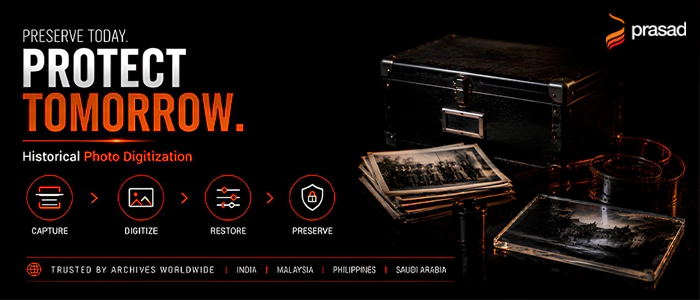
Historical photo digitization converts aged or archival photographic material into accurate, high-resolution digital files while preserving — not “improving” — the original image. A restoration project for a museum or national archive isn’t about making an old photograph look modern; it’s about producing a record that is colour-accurate and faithful to the source, with damage repaired only where it obscures information that was actually there.
A proper workflow covers several stages: high-resolution, colour-accurate scanning calibrated to the original material rather than a generic preset; careful handling of physically fragile formats, including glass plates that can crack under uneven pressure; restoration and tonal balancing to correct fading, foxing, or emulsion damage without erasing authentic detail; and metadata tagging and archival cataloguing so files are searchable and usable, not just stored. For institutions running a digital asset management system, secure DAMS integration is what turns a folder of scans into a retrievable archive.
Digitization of Photographic Prints, Negatives, and Glass Plates
Each format carries its own risk profile. Prints are vulnerable to surface abrasion, fading, and mould; a flat, even scan at the right resolution with minimal handling is usually enough, provided the equipment is colour-calibrated rather than left on automatic correction. Negatives need transmissive scanning to capture the full tonal range a reflective scan would lose, and older acetate-based negatives need extra care given how that material degrades. Glass plate negatives are the most physically demanding of all — heavy, brittle, and often already cracked — and require specialised handling so the plate isn’t stressed during capture. Slides bring their own challenge in dust and colour-fade correction, since ageing slide film often shifts colour unevenly as dyes degrade at different rates.
Getting the digitization of photographic prints and negatives right, across all these formats, is less about one scanner and more about the right process for each one.
Who This Matters For
Museums, government archives, media houses, libraries, and private heritage collections have the most to lose if this work is done poorly, since the original is often one of a kind. The FADGI technical guidelines are a widely referenced benchmark here for exactly that reason — a rushed pass on irreplaceable material isn’t something you get to redo.
Supporting Archives Across Asia and the Middle East
Photo digitization needs aren’t confined to one region, and neither is the material at risk. Museums, cultural institutions, government archives, media organisations, and heritage collections across South Asia, Southeast Asia, and the Middle East face the same underlying challenge: physical photographic material that degrades a little more every year it remains undigitized. A structured workflow — high-resolution scanning, restoration, metadata cataloguing, and secure storage — applies the same standard of care across regions while being adapted to each institution’s format, language, collection requirements, and archival standards.
If your institution is sitting on prints, negatives, slides, or glass plates that haven’t been digitized yet, Prasad Corp’s photograph digitisation services are built to handle exactly this kind of fragile, high-value material — before the next year of storage takes something away for good.
Frequently Asked Questions
1. What is historical photo digitization?
2. What's involved in the digitization of photographic prints?
3. Are glass plate negatives too fragile to digitize?
4. Do you provide photo digitization services outside India?
Ready to Build Your Digital Archive?
Managing a large-scale historical photo collection requires strict safety standards and precise execution. Whether your priority is preserving fragile glass plates, restoring fading film negatives, or making thousands of photographic prints searchable, Prasad Corp is here to help.
Connect with Prasad Corp’s Team Today